Vacant property assessments in Washington, D.C., represent a significant and often misunderstood aspect of the city’s property tax system. Designed to incentivize owners to put their properties to productive use, the District’s approach to taxing vacant and blighted real estate is among the most aggressive in the nation — and for good reason. Housing scarcity, rising rents, and neighborhood disinvestment have made the question of empty buildings a pressing policy concern.
The Basic Framework
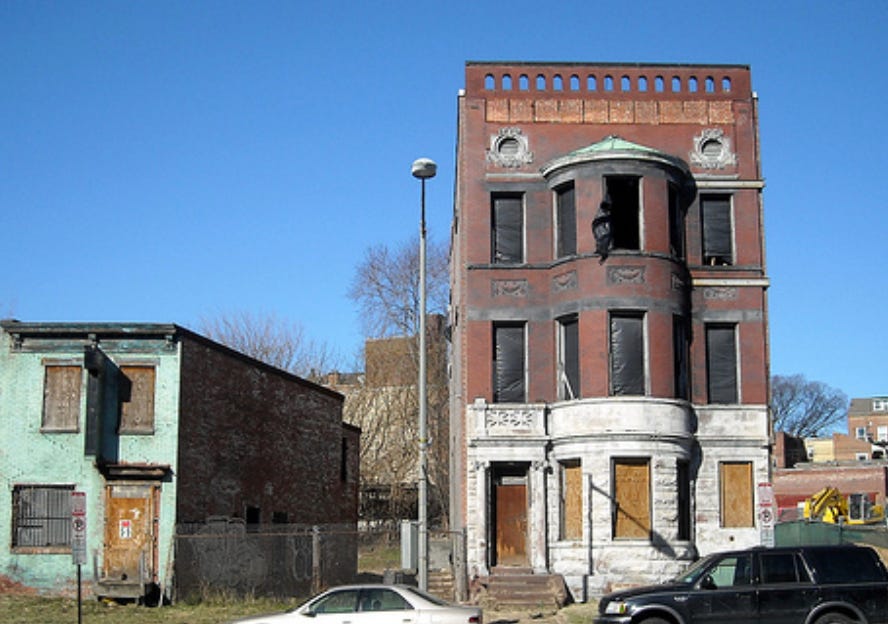
Under DC law, properties are classified into different tax classes, and the classification assigned to a property determines its tax rate. Most residential properties fall under Class 1 (A or B), with rates of $0.85 and $1(for value over 2.558 million) per $100 of assessed value, respectively. Vacant properties, however, are subject to a dramatically higher rate. Properties designated as vacant are taxed at $5.00 per $100 of assessed value — nearly six times the standard residential rate. Properties deemed “blighted,” meaning they pose safety or health hazards or are in serious disrepair, face an even steeper rate of $10.00 per $100 of assessed value.
This punitive tax structure is intentional. The goal is to make holding onto an empty property financially painful enough that owners either develop the property, sell it to someone who will, or at a minimum maintain it in a habitable condition.
How Properties Are Designated Vacant
The Office of Tax and Revenue (OTR) works in conjunction with the Department of Buildings (formerly the Department of Consumer and Regulatory Affairs) to identify and designate vacant properties. A property can be classified as vacant if it is unoccupied and either lacks a certificate of occupancy, has failed an inspection, or has had its utilities disconnected. The designation process typically begins with a complaint, a routine inspection sweep, or a flag triggered by utility data.
Once a property is identified as potentially vacant, the Department of Buildings conducts an inspection. If confirmed, the owner is notified, and the property is placed on the vacant property list, triggering the higher tax
classification for the following assessment cycle. Owners are given an opportunity to appeal the designation, which is an important safeguard given that erroneous designations do occur, particularly for properties that are temporarily unoccupied during renovation or between tenants.
Exemptions and Appeals
Not every empty building automatically faces the punitive rate. The District provides several exemptions for owners who can demonstrate legitimate reasons for vacancy. Properties actively under construction or renovation with valid permits may be exempt. Additionally, properties that are for sale or rent, provided they are being actively marketed, can apply for a vacancy exemption as well. Estate properties caught in probate, properties owned by government entities, and those subject to certain legal disputes may also qualify for exemptions.
The appeals process runs through the Office of Tax and Revenue and, if necessary, the Office of Administrative Hearings. Owners contesting a vacant designation must typically provide evidence of occupancy — utility bills, lease agreements, proof of ongoing permitted construction, or documentation of active marketing efforts. The burden of proof falls largely on the property owner, which can be challenging for estates or out-of-state owners who may not have organized records readily at hand.
Assessment Values and the Double Impact
A critical point often overlooked is that the punitive tax rate applies to the assessed value of the property, not just some nominal figure. The Office of Tax and Revenue assesses properties annually at what it determines to be fair market value. In a city where land values in many neighborhoods have appreciated dramatically over the past two decades, the assessed values underlying these calculations can be substantial. A modest rowhouse in a transitional neighborhood assessed at $600,000 would face an annual tax bill of $30,000 under the vacant rate — a powerful incentive to act.
This double pressure — high assessed values combined with high tax rates — is what gives DC’s vacant property tax its teeth. Critics argue that it can be devastating for low-income longtime homeowners who find themselves unable to maintain or occupy a property due to health, financial hardship, or family circumstances. Advocates for the policy counter that the exemptions are designed to protect such cases and that the overall public interest in reducing blight justifies the framework.
The Broader Policy Goal
Ultimately, vacant property taxation in the District is a land use tool as much as a revenue mechanism. The District faces persistent pressure to produce more housing units and revitalize corridors that have languished for decades. By making vacancy expensive, the City helps move properties back into active use. Whether the current rates strike the right balance remains a live debate, but the underlying logic is straightforward: in a city with as much demand as Washington, DC, a “vacant” property is a civic failure, and the tax code reflects that judgment.
Coming Soon… in fiscal year 2027 (October 2026 - September 2027), the vacant property tax rates and exemptions will undergo a significant overhaul. We will examine those changes in the coming months.