


March 12, 2026 | BillionDollarBroker.net
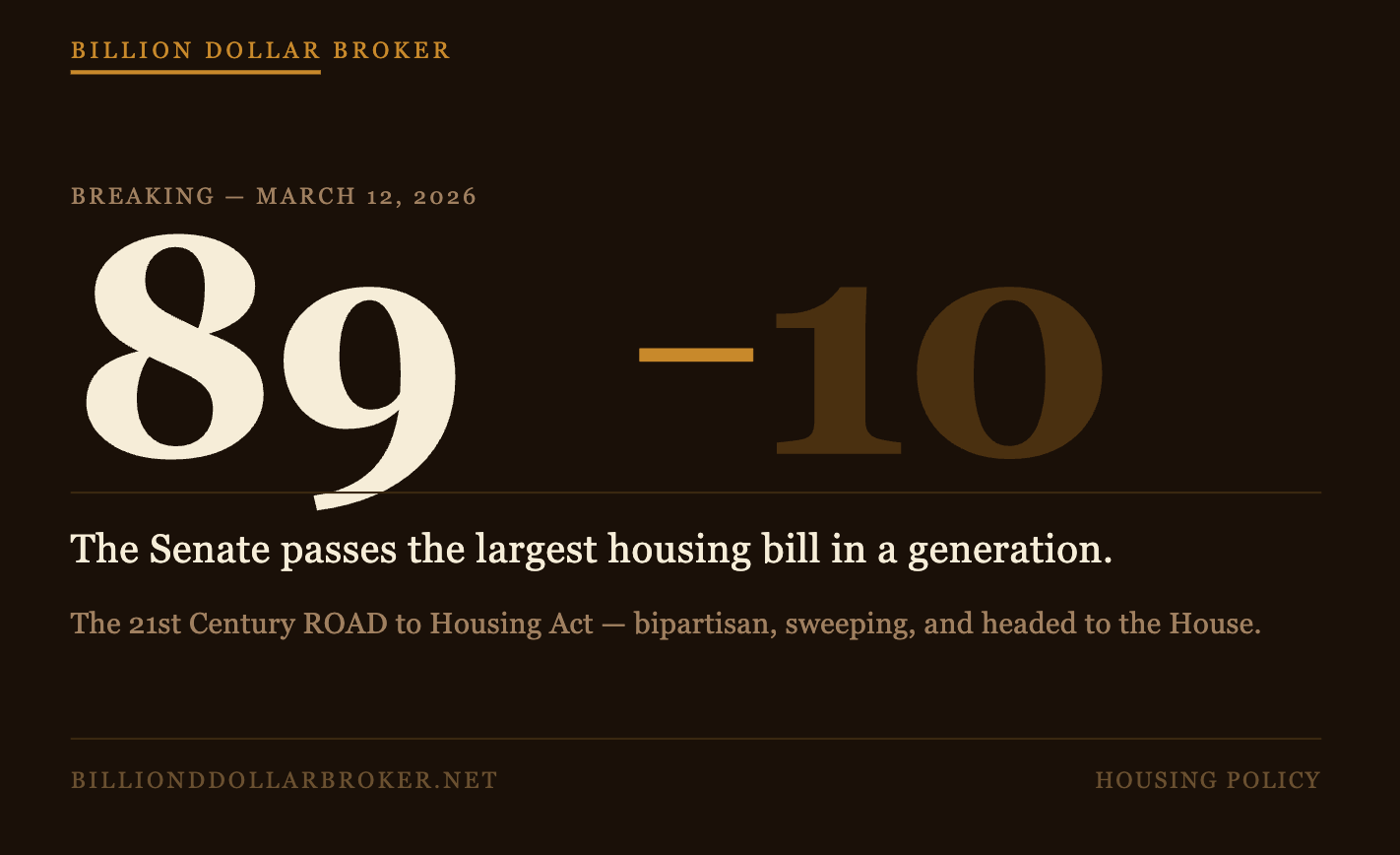
The Senate passed it 89-10. That’s not a typo.
The 21st Century ROAD to Housing Act cleared the chamber Thursday with overwhelming bipartisan support — an 89-10 vote in a Congress that can barely agree on lunch. The bill was written by Tim Scott, the Republican from South Carolina who chairs the Senate Banking Committee, and Elizabeth Warren, the Massachusetts Democrat who sits across from him as ranking member. Two senators who agree on almost nothing. One bill. Eighty-nine votes.
Pay attention.
What the bill actually does
The legislation is designed to improve housing affordability and availability through deregulation, expanding existing programs, and banning institutional investors from buying single-family homes.
That last part is where the political fireworks are, and we’ll get there. But first, the supply side — which is where the real action is for anyone who buys, sells, or owns property.
Outdated housing regulations account for roughly 25% of the cost of building a single-family home and 40% of the cost of a multifamily building. The bill goes after that directly. It streamlines environmental reviews, modernizes manufactured housing rules, unlocks private investment, and updates multifamily financing tools. It also raises the cap on how much banks can invest in affordable housing projects — from 15% of risk-adjusted capital to 20% — which one housing lender called the most impactful provision in the entire package.
What consumers actually get
This is the part most coverage glosses over. Let me be specific.
First-time buyers get more runway. The bill expands eligibility for HOME homeownership assistance to households earning up to 100% of area median income, up from the current 80% cap. That’s a meaningful change. A lot of aspiring buyers have been stuck in the gap — earning too much to qualify for assistance, not enough to compete in the market. This moves the goal posts in their favor.
Veterans get a better shot. The bill ensures veterans are better informed about and able to fully use their VA Home Loan benefits. Sounds like a minor administrative fix. It isn’t. A huge number of veterans leave VA loan benefits on the table because nobody told them they had them. That ends.
Distressed homeowners get help before they lose the house. The legislation helps distressed homeowners with FHA, VA, and USDA loans get access to skilled housing counselors — providing critical support at the moment they need it most. At a time when delinquencies are rising, that’s not a small thing.
Buyers in the middle of the market get a fairer fight. The Wall Street investor ban — which we’ll unpack below — gives everyday buyers a 30-day first-look period on homes before institutional money can move. The bill includes programs to boost homeownership that provide for a right of first refusal and a 30-day “first look” period. That’s a real advantage for buyers who’ve been outbid by cash offers from entities that operate at industrial scale.
The credit market gets modernized. The bill takes steps to improve access to credit and expands access to small-dollar mortgages — the sub-$100,000 loans that banks have largely abandoned because the economics don’t pencil at current fee structures. Rural buyers and buyers in lower-cost markets have been shut out as a result. This legislation tells the CFPB to fix the rules so those loans start making sense again.
The median age of a first-time homebuyer has now climbed to 40. Read that again. The average American now spends two full decades of working adulthood before buying their first home. This bill won’t solve that overnight — but it’s the first serious federal attempt to reverse it.
The Wall Street piece
Here’s where it gets complicated.
One of the most contested provisions bars institutional investors from buying single-family homes, defining a large investor as any entity that directly or indirectly owns 350 or more single-family homes.
Trump called for this in his State of the Union. The Senate put it in. While the bill bans large investors from buying existing homes, it still allows them to build new construction and rehabilitate existing ones — but requires them to sell those properties to real buyers after seven years.
The build-to-rent industry is furious. Seventy-nine industry groups warned that the provision “would effectively eliminate the production of Build-to-Rent housing,” a sector that now accounts for about 7% of new single-family construction.
Here’s my read: the institutional investor ban is good politics and complicated economics. The data does not necessarily support the idea that large investors are a major culprit behind the country’s affordability crisis. The shortage of supply is the culprit. But if you’re a first-time buyer and you just lost your fifth offer to a hedge fund with 50,000 units under management, the data isn’t particularly comforting.
The 30-day first-look window is where the consumer benefit is real and immediate. People over portfolios. For once.
What happens next
Don’t pop the champagne yet.
House conservatives have already blasted the Senate version as “socialism,” complaining that it unfairly restricts institutional investors and strips out parts of the House version that would have deregulated small banks and credit unions. The House passed its own slimmer package last month — about 84% of those provisions made it into the Senate version — but the investor ban wasn’t in it, and that’s the sticking point.
Senate Majority Leader Thune said the quickest path forward would be for the House to pick up the Senate bill and pass it as is. Whether House leadership has the votes — or the stomach — for that is a different question entirely.
Meanwhile, there are signals the White House is distracted. Trump has threatened not to sign any legislation until Congress passes the SAVE America Act, his voter ID priority, though the White House has partially walked that back. A spokesman insists Trump is “laser-focused on making housing more affordable.” We’ll see if that focus survives contact with the legislative calendar.
The bottom line for brokers and their clients
America faces a shortage of nearly 4.7 million homes. That gap is why your buyers are exhausted, why your sellers think they can price whatever they want, and why the market has felt broken for years.
This bill won’t fix that overnight. No bill will. But 89-10 in the United States Senate is not a small thing. It’s the clearest signal we’ve had in years that Washington is finally treating housing like the crisis it is — not a talking point, not a campaign ad, but an actual emergency requiring actual legislation.
When your clients ask what this means — and they will — tell them the government just noticed. Now it has to act.
James Bell is a veteran luxury real estate broker and publisher of BillionDollarBroker.net. Follow him for daily intelligence on the market, the money, and the people who move both.