


Is Now the Time to Buy in London? Americans are the largest block of foreign buyers in the market — and the window is open
The answer is yes. Here’s why I’m saying it out loud.
I’ve been showing American buyers property in prime London since 2016. I know what that market feels like when it’s expensive and indifferent to you, and I know what it feels like when it’s leaning in your direction. Right now, it’s leaning in.
I just came back from London. I toured properties across prime central — Kensington, Mayfair, Chelsea, and Marylebone. What I found surprised even me. Well-priced inventory. Motivated sellers. A city that wants buyers back.

Americans Are Driving the Market
This is no longer sentiment. Americans now account for roughly 25 percent of prime London property purchases, according to major estate agents, with inquiries from U.S. buyers reaching an eight-year high in early 2025. In 2024, Americans overtook Chinese buyers as the largest foreign buyer group in prime central London — a title once held by Middle Eastern royals and Hong Kong billionaires.
The currency math alone is compelling. According to Knight Frank, since July 2014, dollar-denominated buyers have received an effective discount of roughly 38 percent in prime central London — accounting for both currency movement and price softness. Put plainly: $1 million buys around 34 square meters in prime London today, compared to just 23 square meters in 2014. You are getting meaningfully more for your dollar than at any point in the past decade.
The softening at the top of the market has been real. Properties over £5 million have seen a 45 percent increase in price reductions, according to LonRes. For cash-rich American buyers, that’s an opening.

Sotheby’s Is Where the Action Is
Our own brand’s numbers tell the story at the institutional level. UK Sotheby’s International Realty posted £1.63 billion in 2025 sales, led by Mayfair and Knightsbridge in a record prime London year. In 2024, the firm secured the number one market share in both the £10 million-plus and £15 million-plus property segments — all in under two years of rebuilding. When a brand built on discretion and global reach produces numbers like those in a “challenging” market, the underlying demand is real.
On the global side, Sotheby’s International Realty reached $157 billion in 2024 global sales volume — and specifically flagged London as a key market for international expansion.
The Tax Headwind — and Why It May Not Last
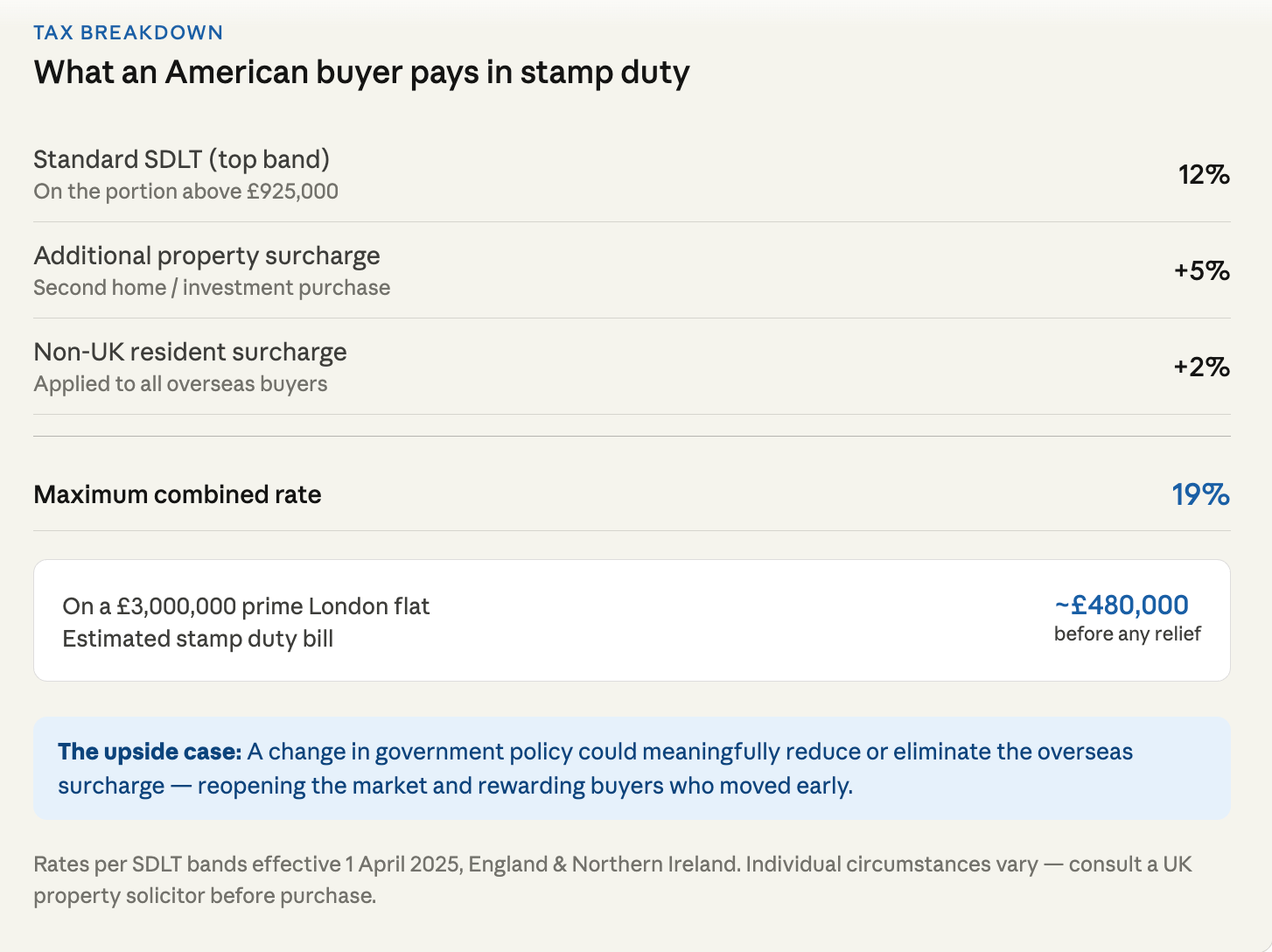
There is a legitimate downside, and I won’t bury it. The callout box above shows the full picture. The short version: an American buying a prime London property as a second home faces standard SDLT, an additional property surcharge, and a non-resident surcharge — stacking to a top rate of 19 percent for overseas buyers purchasing an additional property.
On a £3 million flat in Knightsbridge, you’re writing a tax check approaching £480,000 before you hang a picture. That is real money.
But here’s what experienced buyers understand: taxes imposed by governments can be reduced by governments. Attractive pricing of the right stock has sustained interest from international buyers, as motivated vendors have been willing to conclude on terms that might previously have been rejected. Buyers who moved while sellers were flexible will look very smart if policy shifts and competition returns. The buyers waiting for the tax cut will be competing against each other in a suddenly crowded market
What I Saw on the Ground
I toured properties that in 2021 would have had competing offers before the second viewing. Today, they are available, priced with intention, and represented by agents who are ready to engage. Prime London hasn’t lost its fundamentals — the architecture, the neighborhoods, the global demand from tenants, the cultural gravity. What it shed was the frothy premium. That is exactly when serious buyers move.
I’ve had this conversation with clients across the DC–London corridor for nearly a decade. The ones who acted when the market gave them an opening are glad they did. The ones who waited for certainty are still waiting.
The Bottom Line
Prime London is not distressed. It’s disciplined. Inventory is available, sellers are realistic, the dollar is strong, and Americans are the most active cohort of foreign buyers in the market. The tax burden is real — but it’s a policy number, not a permanent condition.
If you’ve been thinking about London, this is the moment to have the conversation. I just walked those streets. I know what’s available and what it’s priced at.
The window is open.